When researchers haul up a net from below 5,000 meters, roughly 90% of what wriggles out has never been described by science. That’s not an exaggeration from a documentary.
That’s the working estimate Guadalupe Bribiesca-Contreras of London’s Natural History Museum gave after her team logged 39 new species in one stretch of Pacific seafloor. Nine out of ten. Most of the ocean floor is, in the most literal sense, full of strangers.
So the question isn’t really “what weird thing did they find?” It’s “which of the thousands of weird things is worth telling you about?”
I’ve got opinions on that.
The ghost that still doesn’t have a name
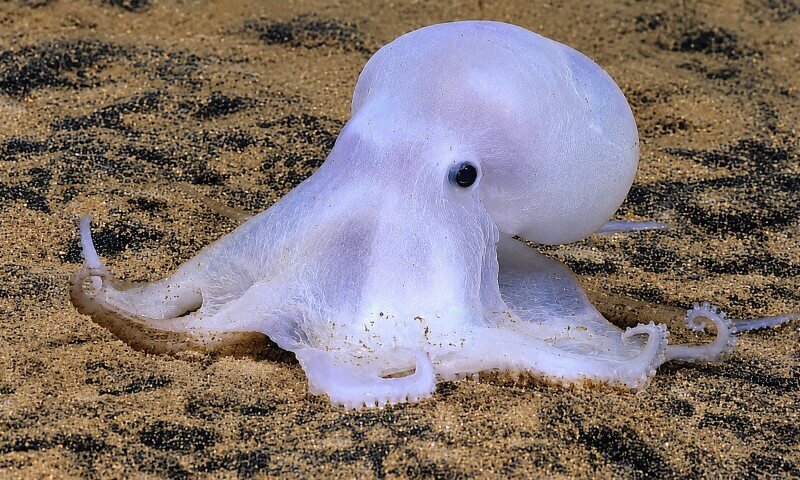
In February 2016, a NOAA robot called Deep Discoverer was exploring a flat patch of rock northeast of Necker Island, near Hawaii, collecting geological data. At 4,290 meters down it bumped into a small, completely colorless octopus sitting on the seafloor.
It had no pigment, no fins, and a slightly gelatinous body. The pilots couldn’t identify it, and someone on the boat said it looked like Casper the cartoon ghost. The name stuck.
Females lay around 30 eggs on the dead stalk of a sponge, then wrap their whole body around the clutch and brood. For years, possibly. They essentially starve themselves into a slow vigil in the cold and the dark.
A decade later, Casper still has no formal scientific name.
Why? Because the old rules of taxonomy demand a physical specimen – a “holotype” you can pickle in a jar and point to forever.
Nobody has ever collected a Casper. Every sighting so far has been on video. Without a Latin name on the books, it is much harder to list a creature as endangered.
That matters here because Casper lays its eggs on sponges that grow on manganese nodules, and those nodules are exactly what deep-sea mining companies want to remove from the seafloor.
A nameless animal is much harder to protect. This problem sits at the center of deep-sea research today, and we’ll come back to it.
The supergiant they found in a seafood market
Not every discovery happens two miles under the waves with a million-dollar submersible. Some happen at a fish stall.
In 2022, staff from Hanoi University bought four giant isopods from a market in Quy Nhơn City, Vietnam, where the animals had become a local delicacy. Some people there even compare them to lobster.
Two specimens went to crustacean expert Peter Ng in Singapore. By early 2023 his team realized they were holding something nobody had ever described, and in January 2025 they published it: Bathynomus vaderi.
Yes. Darth Vader. The head looks unnervingly like the helmet, and Ng – by his own admission the biggest Star Wars fan on the team – couldn’t resist.
Picture a woodlouse the length of your forearm, with two pairs of antennae and four sets of jaws, scavenging whale carcasses on the bottom of the South China Sea. It is harmless to humans, though still not exactly easy to look at.
What I love about vaderi is the lesson buried in it. A creature this large, this dramatic, hidden in plain sight until somebody happened to eat one.
As the researchers put it bluntly, that something so big could stay hidden so long tells you exactly how little we understand about the deep sea.
Three weeks in an Argentine canyon
One of the clearest looks at how strange the deep sea can get came from what the Falkor (too) found off Argentina in 2025.
Two miles down, off the coast of Mar del Plata, sits a canyon nearly twice as deep as the Grand Canyon. Over roughly three weeks in July and August, the Schmidt Ocean Institute’s robot recorded more than 40 species that may be new to science.
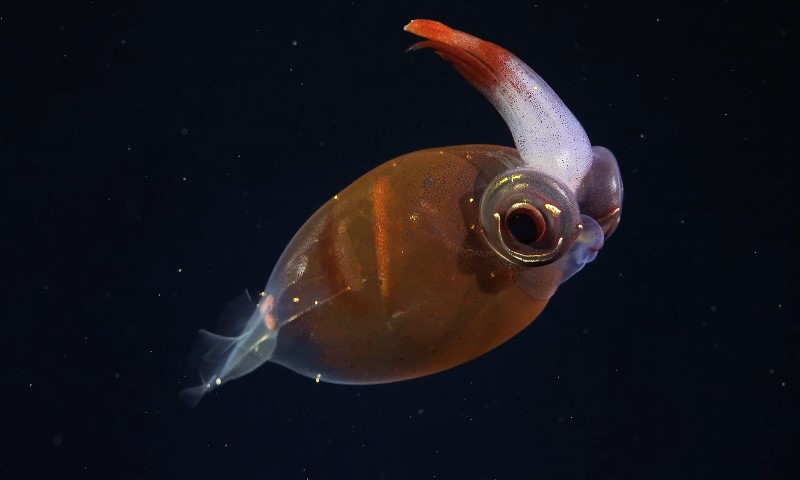
The footage is hard to forget. A see-through squid with a horn-like bundle of arms. A telescope octopus, translucent, hanging in the water column like a held breath. A king crab lumbering along with about 100 barnacles hitchhiking on its shell.
Then came Stygiomedusa gigantea, the phantom jellyfish, with trailing arms long enough to make it about the length of a school bus. It has only been seen a handful of times in more than a century.
Then there’s my favorite detail, the kind no fiction writer would dare invent. On a separate South Atlantic leg, the team filmed a whale fall – a whale skeleton that had been feeding the seafloor for decades, drawing in bone-eating Osedax worms and squat lobsters living in beds of clam shells.
Near that old carcass, three kilometers down, they also found an old VHS tape. Even at the bottom of the planet, traces of us are already there.
A whole new branch of the family tree
Sieh dir diesen Beitrag auf Instagram an
Most “new species” are variations on something already known: another worm, another sea cucumber, a slightly different anemone. Every so often, though, the deep sea produces something that changes how scientists understand a whole group.
In March 2026, researchers from the National Oceanography Centre in Southampton described 24 new amphipods from the Clarion-Clipperton Zone, that enormous stretch of Pacific between Hawaii and Mexico. One of them didn’t just turn out to be a new species.
It was an entirely new superfamily – a branch of crustacean life nobody knew existed, sitting there the whole time.
The CCZ is central to this work for a reason. It is also covered in metal-rich nodules, the same kind being targeted for batteries and turbines.
Researchers are now trying to formally name 1,000 of the zone’s unknown animals by 2030, while mining interest in the area continues to grow.
In some places, the effort to understand these animals is happening alongside the risk of losing their habitat.
The creatures we’d only ever seen dead
One more, because it captures something the others don’t.
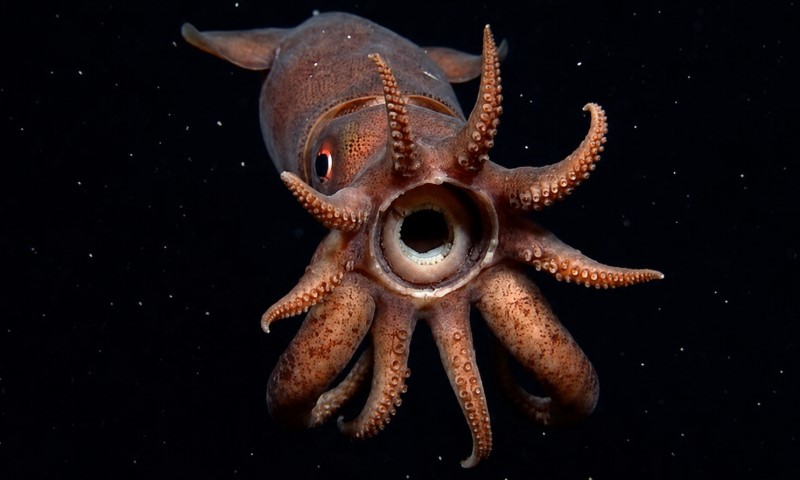
In 2024, off a newly mapped seamount, scientists got live camera footage of a Promachoteuthis squid – a genus so rare it had basically only been known from a few dead specimens, some collected back in the 1800s.
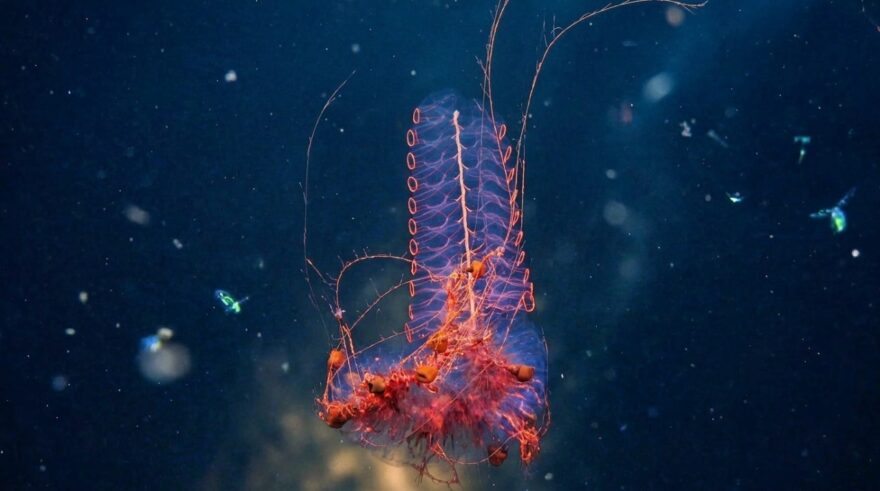
On the same kind of expedition, cameras caught the “flying spaghetti monster,” a siphonophore that isn’t one animal at all but a colony of specialized clones called zooids, working together as a single drifting organism.
So what’s actually going on down there?
The main lesson from the last decade is not really about any one animal. It is that the deep sea is revealing life much faster than we can formally describe it. The limit was never just the ocean itself, but our slow process for confirming, comparing, naming, and protecting what researchers find.
That process is starting to change. DNA barcoding and shared imaging databases are helping scientists move faster. At the same time, the urgency is growing.
Some of the same mineral-rich areas where researchers are finding ghost octopuses and entirely new branches of life are also being considered for deep-sea mining. There is a real chance that some species could disappear before they are formally named.
Eight years after a robot filmed Casper sitting on its rock, we still can’t officially call it anything. Think about what that says. We’ve photographed the surface of Mars in higher resolution than most of our own seabed, and the strangest animals on Earth are still showing up faster than we can write them down.
Keep an eye on the next research vessel headed somewhere with a metal-rich bottom. Whatever it finds, it’ll be weirder than anything I just described – and there’s a decent chance it’ll be new.