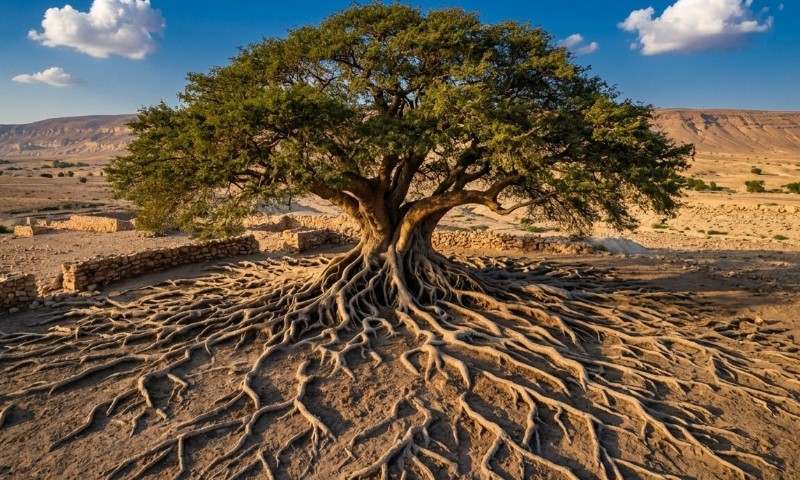
A twisted ancient tree can outlast kingdoms, languages, monuments, and entire systems of power. Its bark records injury, weather, drought, and time on a scale far longer than human memory.
Some trees survive as single organisms for thousands of years. Others live as clonal colonies, where new trunks grow through an ancient root system.
Bristlecone pines represent individual endurance. Aspen groves represent renewal.
Longevity, then, can mean two different things: one ancient trunk refusing to die, or one ancient root system replacing its visible stems again and again.
Clonal colonies may reach 10,000 years or more, but precise dating is difficult because their oldest tissue has usually decomposed.
Ancient trees act as living archives. They record climate shifts, ecological stress, and human impact while civilizations rise and fall around them.
Bristlecone Pine
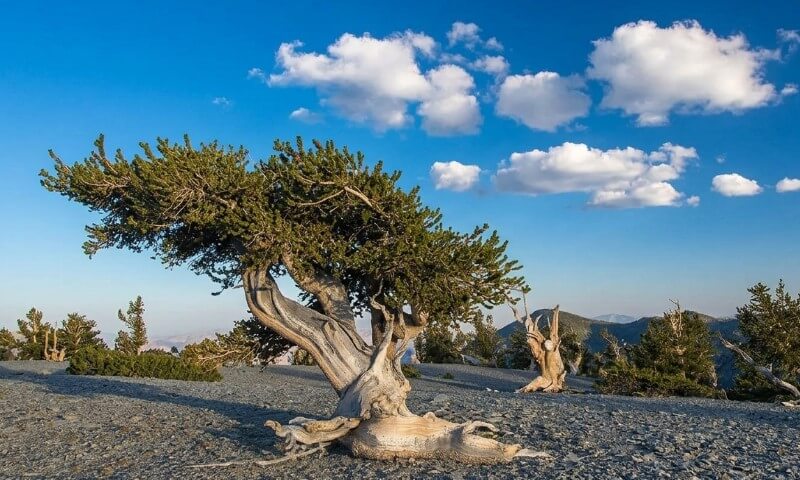
Great Basin bristlecone pine, or Pinus longaeva, ranks among Earth’s longest-lived individual tree species.
It grows in the White Mountains and Inyo Mountains of California, as well as harsh mountain ranges in Nevada and Utah.
Many bristlecones live near 10,000 feet above sea level. Cold air, strong wind, thin soil, and short growing seasons slow their growth. Those same harsh conditions help them survive.
Slow growth creates dense wood. Dense wood resists insects, fungi, rot, erosion, and decay. Sparse vegetation around high-elevation bristlecones also lowers wildfire risk.
Several biological traits help explain why Great Basin bristlecone pines can live for millennia:
- Lifespan can exceed 5,000 years.
- Mature height can reach about 50 feet.
- Trunk diameter can reach about 154 inches.
- Needles may live up to 30 years, which helps conserve energy.
- Cones take about two years to mature.
- Claw-like bristles on cone scales give the species its name.
Methuselah is the most famous known bristlecone pine. It grows in California’s Inyo National Forest at about 10,000 feet above sea level.
Its exact location is secret to protect it against vandalism, relic hunters, foot traffic, and damage to fragile soil.
Age estimates vary because ancient tree dating can depend on sample quality, method, and interpretation:
- One source lists Methuselah at 4,842 years old.
- Another states it was 4,789 years old when examined in 1957.
- Estimated seeding date has been placed at 2833 B.C.
- Scientific discussion places it well over 4,500 years old.
- One of its oldest extracted rings may date to either 2490 or 2555 B.C.E.
Methuselah was alive near the dawn of Egyptian civilization.
It was already centuries old during the building of Stonehenge and more than 500 years old when early Chinese civilization was beginning along the Yellow River.
An unnamed bristlecone pine in the White Mountains may be older than Methuselah. Its identity is protected.
Prometheus
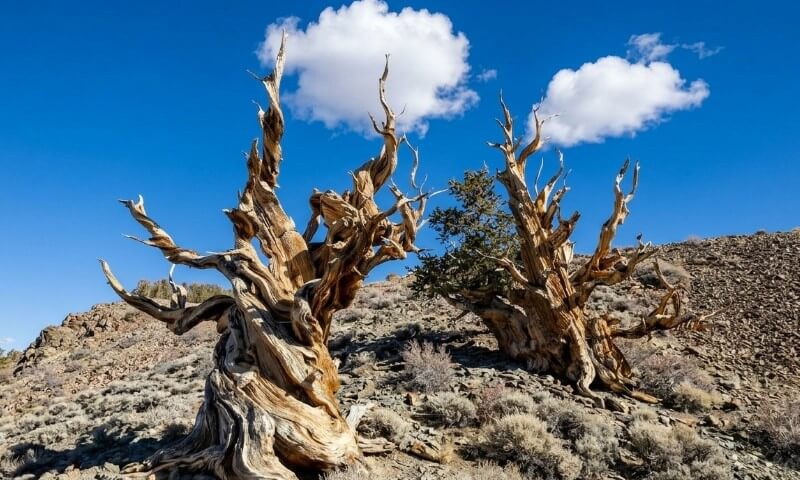
Prometheus was a Great Basin bristlecone pine originally labeled WPN-114.
It grew on Wheeler Peak in Nevada’s Snake Range, now part of Great Basin National Park.
In 1964, a graduate student researcher tried to extract a complete core sample. After failing, he had the tree cut down to study its stump.
Only then did its age become clear. Prometheus was one of the oldest trees ever known.
Prometheus became a warning. Ancient trees can reveal climate history, growth records, and survival patterns, but careless study can destroy what researchers seek to learn.
Its death changed how ancient trees are treated. Modern protection practices became more important after researchers saw what had been lost:
- Careful coring.
- Stronger site protection.
- Restricted access.
- Secrecy around exact locations.
- Greater caution around destructive sampling.
Prometheus shows the cost of curiosity without enough caution: science gained data, but Earth lost an irreplaceable living organism.
Pando
View this post on Instagram
Pando, also called the Trembling Giant, is a clonal colony of quaking aspen in Utah. It looks like a forest, but it is one male organism.
Individual trunks can die while the larger organism continues producing new growth.
Pando’s scale makes it hard to compare with a normal tree:
- Area: more than 100 acres.
- Estimated age: over 80,000 years.
- Combined weight: over 6,600 tons.
- Biological form: one male quaking aspen clone.
- Visible structure: many stems connected by one root system.
Pando changes the definition of a tree. Is the true organism the trunk aboveground or the root system below?
In Pando’s case, survival depends on renewal, not one permanent body.
Old Tjikko and Ancient Root Systems of the North
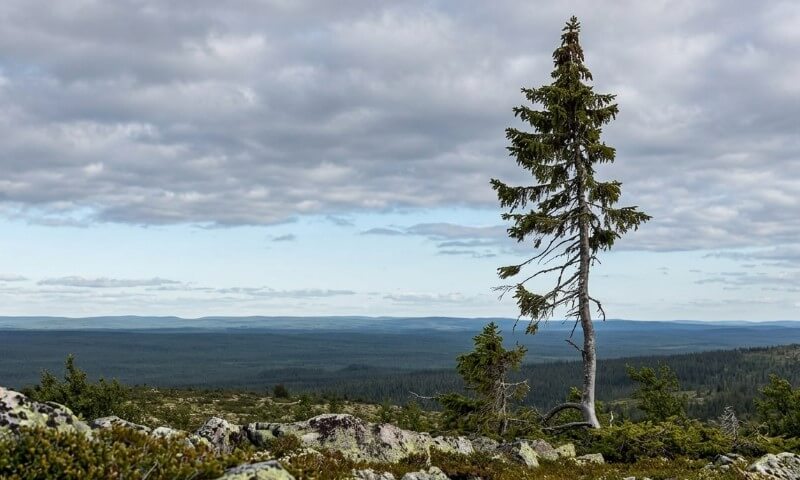
Old Tjikko is a Norway spruce in Sweden’s Fulufjället Mountains. It is about 16 feet tall and does not look especially ancient.
Its visible trunk is only a few hundred years old, but its root system is about 9,550 years old.
That makes Old Tjikko one of the most famous examples of clonal tree survival.
A few details make its age easier to grasp:
- Species: Norway spruce.
- Location: Fulufjället Mountains, Sweden.
- Visible height: about 16 feet.
- Root-system age: about 9,550 years.
- Trunk age: only a few hundred years.
A trunk can die. Roots can persist. New stems can rise through the same living system. Old Tjikko proves that ancient age can be hidden underground.
Its root system reaches back close to the end of the last Ice Age.
A small, weathered spruce in Sweden is connected to nearly 10,000 years of ecological history.
Ancient Trees Around the World
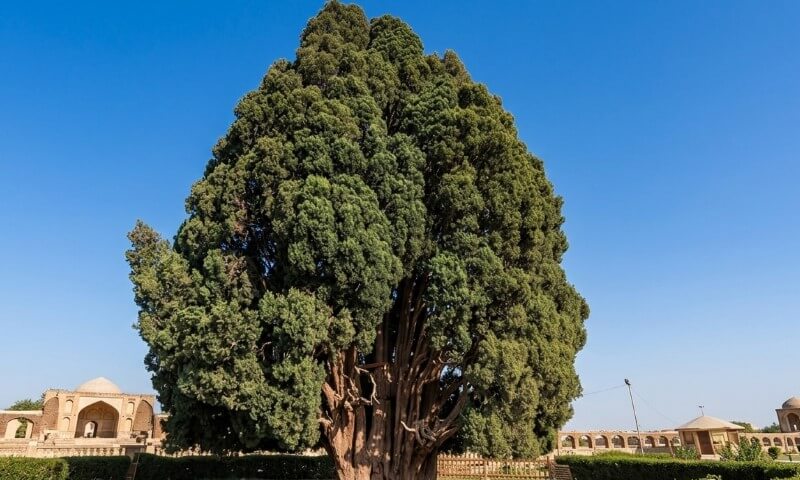
Ancient trees grow across many continents, climates, and cultures.
Sarv-e Abarqu, also called the Zoroastrian Sarv or Cypress of Abarqu, grows in Abarkooh in Yazd province, Iran.
It is estimated to be at least 4,000 years old, with some estimates placing it between 4,000 and 4,500 years old. It is often described as the oldest living organism in Asia and is considered an Iranian national monument.
Llangernyw Yew grows in the churchyard of St. Dygain’s Church in Llangernyw village, North Wales. Its age is estimated at about 4,000 years.
It has been identified as one of the oldest non-clonal trees in the world.
In 2002, it was named one of 50 Great British Trees for Queen Elizabeth II’s Golden Jubilee. Welsh mythology links it to Angelystor, the “Recording Angel.”
Alerce, or Fitzroya cupressoides, is a Patagonian cypress native to the Andes of Chile and Argentina.
Confirmed ages place alerce at at least 3,613 years, while one specimen has been cited at 3,637 years using tree-ring width chronology. Chilean scientists recognized as early as the 1860s that alerce could live 2,500 years or more.
Gran Abuelo, also called Alerce Milenario, may be even older.
In 2022, a Chilean scientist estimated it at 5,484 years old, with an 80% probability of being over 5,000 years old. That age is debated because it relies on partial coring and statistical modeling rather than full tree-ring confirmation.
Giant sequoias in California rank among the largest trees on Earth, but size does not equal age.
Several famous examples show why bigger does not always mean older:
- Giant sequoia longevity can reach at least 3,266 years.
- General Sherman is the world’s largest tree.
- One estimate placed General Sherman at about 2,150 years old.
- Yosemite’s Grizzly Giant was estimated at about 1,790 years old.
How Trees Live So Long
Extreme longevity depends on slow growth, dense wood, damage control, pest resistance, energy conservation, clonal regeneration, and a favorable habitat.
Bristlecone pines show the pattern clearly. Cold temperatures, high winds, thin soil, and short growing seasons slow growth and create dense wood.
Dense wood helps resist insects, fungi, rot, erosion, and decay.
Energy conservation also helps. Bristlecone needles may live up to 30 years, reducing the cost of constant replacement. Their cones take about two years to mature.
Damage control is essential. Ancient trees can seal off injured tissue while healthy parts keep living.
A tree can lose branches, bark sections, or internal wood and still survive.
Clonal regeneration adds another path. Pando and Old Tjikko show how roots can outlive trunks. In clonal systems, survival comes through repeated replacement.
Several long-life traits tend to appear again and again across ancient trees:
- Slow growth that limits stress.
- Dense wood that resists decay.
- Long-lived needles or leaves that conserve energy.
- Ability to seal off damaged tissue.
- Harsh habitats with less competition.
- Root systems capable of regeneration.
- Reduced wildfire risk in sparse environments.
Gymnosperms often dominate extreme-age lists.
Pines, yews, firs, spruces, cedars, redwoods, cypresses, and ginkgo generally grow slower and live longer than flowering plants.
Roughly 25 gymnosperm species can live 1,000 years or longer.
Cypress-family trees include many millennial species, while the longest-lived species is a pine with an effective age limit near five millennia.
Long life requires biology, habitat, and luck. A tree must resist decay, avoid major fire, survive drought, withstand storms, and escape destructive human activity.
What Ancient Trees Teach Us
Ancient trees make human time feel brief. Empires count centuries. Bristlecone pines count millennia. Clonal forests can count tens of thousands of years.
Ancient trees are not relics. They are living organisms still responding to weather, soil, disease, climate stress, and human pressure.
Their lesson is simple: survival takes patience, adaptation, endurance, renewal, and protection.
A tree that took 5,000 years to grow can be damaged in minutes, so its value must be measured in more than one human lifetime.