Some of the loudest birds can scream at shocking volumes. Noisy habitats, especially dense forests, make strong calls useful because leaves, trees, insects, rain, and other animals can block or cover softer sounds.
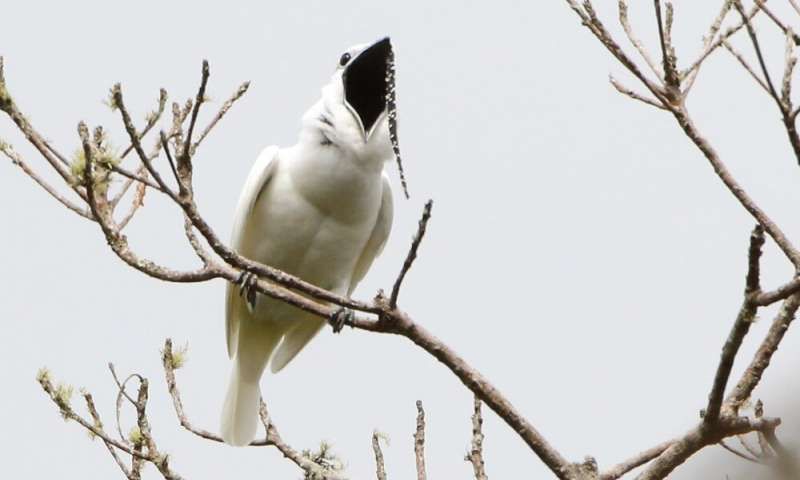
Male white bellbirds produce the loudest known bird call, reaching about 125 decibels. Such volume is roughly comparable to a rock concert. A normal human voice is about 60 decibels, so the white bellbird’s call is extreme by comparison.
Loud bird calls are not random noise. Birds use powerful sounds to survive, attract mates, communicate with others, defend territory, and compete against rivals.
Among the loudest birds, volume often gives an animal a better chance to be noticed in a crowded, noisy habitat.
The Loudest Bird is White Bellbird

Among the loudest birds, the white bellbird has the strongest recorded bird call.
Male white bellbirds can reach about 125 decibels, with some measurements reported near 125.4 decibels. That volume is close to a rock concert and far above a normal human voice, which is about 60 decibels.
White bellbirds live in cloud forests of the northern Amazon, especially northern Brazil and southern Venezuela.
Dense vegetation, rain, insects, and other animal calls create heavy background noise, so a powerful sound can help a bird be heard.
Male white bellbirds are bright white with a black bill and a long black wattle near the beak. Females look different, with greenish feathers and brown streaks that help them stay hidden in forest cover.
White bellbird calls are short, booming, and split into two parts. Their calls are louder than screaming piha calls and have about three times the sound pressure of the piha’s song.
Researchers found two main song types in male bellbirds:
- Type 1 is quieter and longer.
- Type 2 is louder and shorter.
- Type 2 carries the record-level volume linked to courtship.
During courtship, a male may turn toward a nearby female and blast the final note directly at her. Females often move away after the sound, yet they may stay close. That behavior suggests extreme volume plays a role in mate choice, even when the call is intense at close range.
A louder male may signal strength, health, and strong body condition. Since the call is difficult to produce, it may help females compare males during the breeding season.
Among the loudest birds, the white bellbird is the clearest example of sound used as a courtship display.
Other Loud Birds

Screaming pihas are also among the loudest birds in the Amazon.
Before white bellbirds became known as the loudest recorded birds, screaming pihas were often treated as one of the top examples of extreme bird volume. Their calls can be heard more than half a kilometer away.
Screaming pihas belong to the cotinga family, the same wider bird group as white bellbirds. Males are plain gray, so sound is their main display. Their sharp, repeated calls travel well through forest cover and help males advertise their presence.
Moluccan cockatoos, native to Indonesia, can reach around 130 decibels.

Their loud screeches help with warning calls, flock contact, and communication over distance. In social birds, a powerful voice helps group members react to danger and locate one another.
Macaws also belong among the loudest birds. Their harsh calls help flock members keep in contact while feeding, flying, or moving through trees. Strong calls are useful when individuals are spread out and blocked by vegetation.
Peacocks use loud calls during the breeding season. Males call to attract females and announce their presence. Their cries are sharp, repeated, and easy to hear across open areas.
View this post on Instagram
Why Birds Scream
Birds scream because volume helps solve survival and breeding problems.
A quiet call may fail in a noisy forest, crowded colony, or moving flock. Among the loudest birds, screaming is usually tied to communication, mating, warning, or defense.
Mate attraction is one major reason. During breeding season, males often call more often and more loudly. Strong calls can help females notice a male and may show that he has the strength and energy needed for display.
Territory defense is another reason. A loud call can tell rivals that an area is occupied.
Calling can reduce direct fights because rivals hear the warning before coming closer.
Alarm calls help birds react to danger. A loud warning can alert mates, chicks, flock members, or nearby birds when predators approach. Fast warnings can help birds hide, freeze, mob a predator, or fly away.
Several pressures can make loud calls valuable:
- Dense vegetation that blocks softer sounds.
- Rain, wind, insects, and animal noise.
- Crowded colonies with many birds calling at once.
- Competition among males during breeding season.
- Predator threats that require fast warning calls.
- Group movement that depends on contact calls.
In white bellbirds, extreme volume is likely shaped by female choice. Louder males may seem stronger, healthier, or more impressive. A male that can produce such a powerful sound may gain a mating advantage.
How did the Loudest Birds Get So Loud?
Birds make sounds with the syrinx, a vocal organ near the base of the trachea. It controls loudness, tone, and call complexity. In the loudest birds, the syrinx works with breathing, muscles, posture, and body shape.
White bellbirds appear built for extreme volume. Their wide-opening beaks, unusual throat shape, thick abdominal muscles, and specialized ribs may all help produce powerful calls.
Since males weigh less than 250 grams, their record-level volume depends on efficient body mechanics.
Beak shape matters. White bellbirds eat mostly fruit, including fruit large enough to require a wide gape. That wide mouth opening may also help sound projection. Their beak has been compared to the bell of a trombone because it can help aim sound outward.
Physical traits linked to white bellbird volume include:
- A very wide gape that opens the sound path.
- Strong abdominal muscles help push air.
- Specialized ribs linked to forceful calling.
- The throat and mouth shape that help project sound.
- Short call length that concentrates power into a brief burst.
A major trade-off exists between volume and duration. As white bellbird and screaming piha songs get louder, they get shorter.
Limited airflow and breath control likely prevent the birds from keeping maximum volume for long.
Screaming pihas use a longer call that builds to a powerful peak. White bellbirds use a shorter blast with greater force. That difference helps explain why the white bellbird reaches a higher measured volume.
Summary
The loudest birds scream because volume helps them compete, communicate, defend territory, warn others, and reproduce. In noisy habitats, a powerful call can make the difference between being heard and being ignored.
White bellbirds give the clearest example. A small Amazon bird can produce one of the loudest calls ever recorded, using an intense courtship sound to impress females. Natural selection and mate choice turned a simple bird call into an extreme display of power.