Some carnivorous plants do more than make energy through sunlight. They attract insects, trap them, digest them, and absorb nutrients that help them survive in soil where ordinary plants struggle.
Many grow in boggy, sandy, acidic, or nutrient-poor places. Insects supply nitrogen and phosphorus, two nutrients often missing in those habitats.
Many species are hard to grow at home. They often need exact water, soil, light, humidity, and dormancy conditions, so they are not always easy-care houseplants.
So, what are carnivorous plants that turned leaves into traps that catch, hold, and digest insects?
| Plant | Scientific Name | Trap Type | Main Prey | Native Range |
|---|---|---|---|---|
| Venus Flytrap | Dionaea muscipula | Snap | Insects, spiders | Carolinas |
| Tropical Pitcher Plant | Nepenthes spp. | Pitfall | Insects, small vertebrates | Eastern Hemisphere tropics |
| Purple Pitcher Plant | Sarracenia purpurea | Pitfall | Insects | Eastern North America |
| Cobra Lily | Darlingtonia californica | Pitfall | Insects | Oregon, Northern California |
| Sundew | Drosera spp. | Sticky | Small insects | Multiple continents |
| Butterwort | Pinguicula spp. | Sticky | Gnats, fruit flies | Americas, Eurasia |
| Bladderwort | Utricularia spp. | Suction | Tiny aquatic prey | Boggy or aquatic habitats |
| Waterwheel Plant | Aldrovanda vesiculosa | Snap | Tiny aquatic prey | Aquatic habitats |
| Portuguese Sundew | Drosophyllum lusitanicum | Sticky | Insects | Spain, Portugal, Morocco |
| Moccasin Plant | Cephalotus follicularis | Pitfall | Insects | Southwest Australia |
1. Venus Flytrap
View this post on Instagram
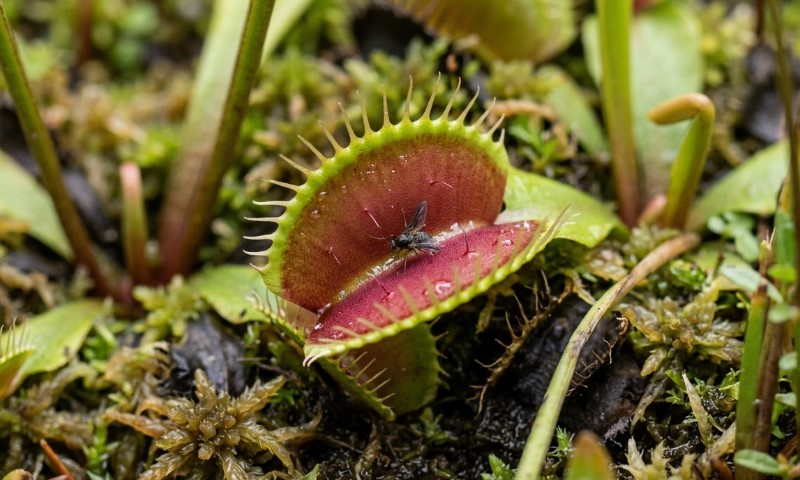
Venus flytrap, or Dionaea muscipula, is the best-known name among carnivorous plants. Real plants are much smaller than their pop-culture image, but their trap system is highly precise.
Each leaf ends in two hinged lobes that work like a small jaw. Inside the trap, hair-like projections called trichomes sense movement. A trap usually closes only after repeated contact, which helps the plant avoid wasting energy on rain or debris.
One key detail makes the trap even more precise:
An insect must touch two different interior hairs within about 20 seconds for the trap to shut.
Despite its name, Venus flytrap eats more than flies. Its prey can include spiders, beetles, grasshoppers, and other small arthropods. Once the trap seals, digestive fluids break down the prey so the plant can absorb nutrients.
Native habitat and size are limited:
- Scientific name: Dionaea muscipula
- Native range: a small area in North and South Carolina subtropical wetlands
- Mature size: about 6 to 12 inches tall
- Typical trap size: about 1 inch long
- USDA Growing Zones: 5 to 8, with winter protection often needed in Zones 5 and 6
Venus flytrap is not the largest carnivorous plant, but its fast snap trap makes it the most recognizable.
2. Tropical Pitcher Plant
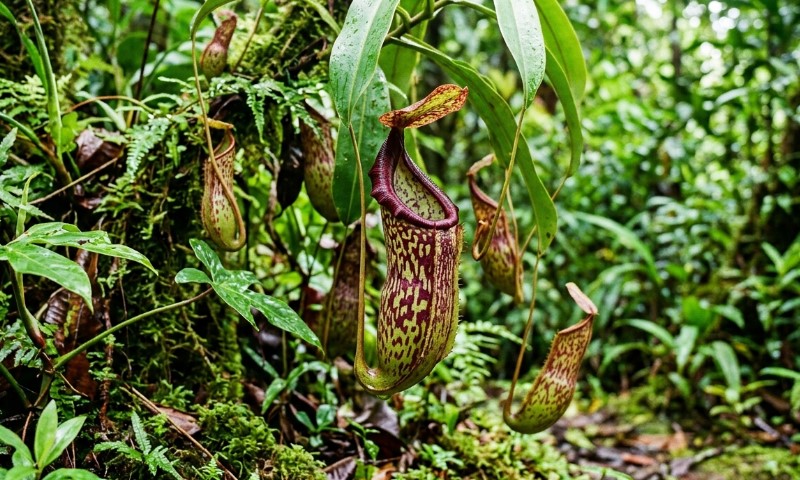
Tropical pitcher plants, or Nepenthes species, grow hanging pitcher-shaped traps that look like cups.
Insects land near the rim, slip inside, and fall into trapped liquid. Once inside, they may drown or slowly break down in digestive fluid.
Several details make Nepenthes one of the most dramatic carnivorous plants:
- Species count: about 150 or more
- Range: Madagascar, Southeast Asia, Australia, and other parts of the Eastern Hemisphere
- Mature vine length: up to 45 feet
- Pitcher size: often about 14 to 16 inches long
- USDA Growing Zones: 10 to 11
- Common growing setup: sphagnum moss in pots, often in greenhouses
Some pitchers can grow more than a foot tall. Larger species may trap small lizards, amphibians, birds, or small mammals, not just insects. Digestion can take as long as two months.
Woody vines and hanging pitchers also make many Nepenthes plants suitable for hanging baskets when light, humidity, and growing media are carefully managed.
3. Purple Pitcher Plant
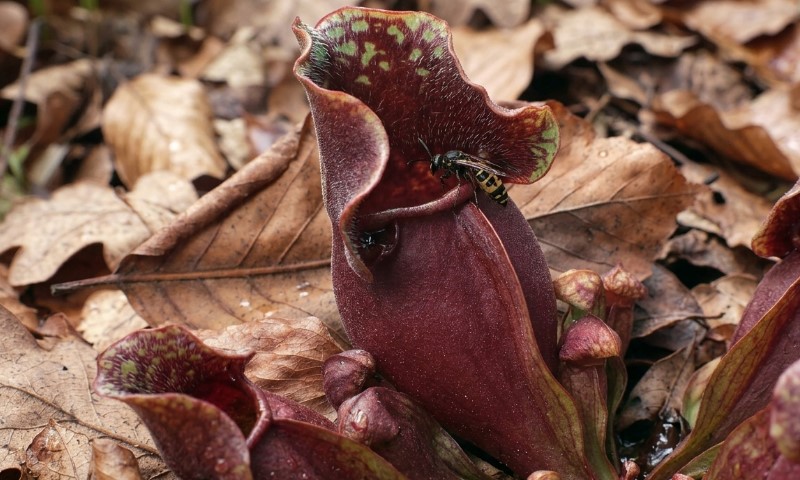
Purple pitcher plant, or Sarracenia purpurea, is a North American bog predator. It catches insects with pitcher-shaped leaves that act as pitfall traps.
Nectar around the pitcher lip attracts prey. Once insects crawl inside, slick walls and downward-pointing hairs make escape difficult. Water can collect in the pitcher and drown trapped insects, while chemicals help break prey down.
Key growing and identification details include:
- Scientific name: Sarracenia purpurea
- Native range: eastern seaboard
- USDA Growing Zones: 3 to 6, depending on subspecies
- Pitcher length: usually 6 to 8 inches
- Flower color: red
- Pitcher color: greenish
- Soil needs: full sun with boggy, acidic soil
Purple pitcher plant has many subspecies and is usually grown in specialized bog gardens rather than as a typical houseplant.
About ten Sarracenia species are native to North America. Poor soil is central to their feeding behavior, since captured insects supply nitrogen and phosphorus that the roots cannot get in large amounts.
4. Cobra Lily
Cobra lily, or Darlingtonia californica, looks like a cobra rising to strike. Its inflated pitcher, curved top, and forked appendages make it one of the strangest-looking carnivorous plants.
Prey enters after following a sweet scent. Once inside, the trap becomes confusing.
Closed pitchers contain see-through false exits that make insects waste energy trying to leave through spots that do not open.
Its habitat needs are exact:
- Common name: California pitcher plant
- Scientific name: Darlingtonia californica
- Native range: cold-water bogs in southern Oregon and Northern California
- USDA Growing Zones: 6 to 9
- Mature size: about 29 inches tall
- Flower color: yellow to purplish green
- Soil needs: gravelly, boggy soil saturated with cold water
- Light needs: full sun to part shade
Cobra lily is very difficult to grow because its roots need cool, oxygenated water. Many gardeners have better luck admiring it in its native habitat than forcing it into ordinary pot culture.
Naturalists have not clearly identified its natural pollinator, which adds another unusual detail to a plant already known for its deceptive trap design.
5. Sundew
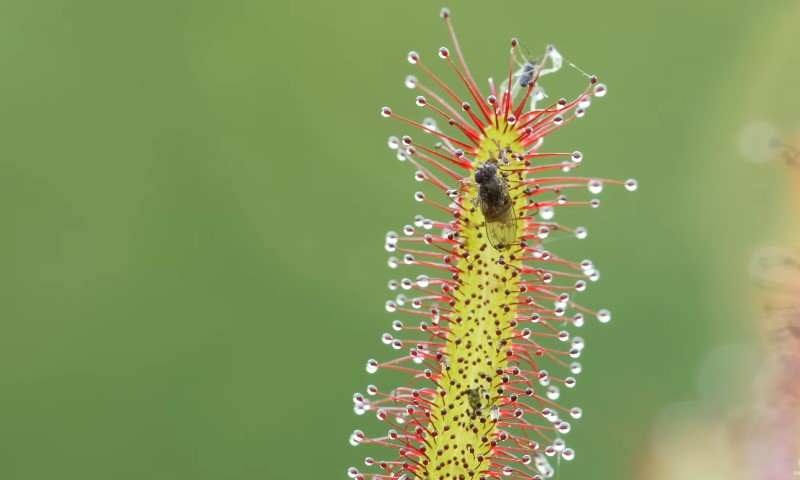
Sundews, or Drosera species, look delicate, but their sparkling droplets are traps. What looks like dew is actually a sticky secretion on hair-like tentacles.
Small insects land on the shiny droplets and get stuck. As prey struggles, more tentacles may bend toward it. In some species, the leaf curls around the insect.
Digestion starts after the insect is trapped. Enzymes released by the leaves dissolve soft tissues, and the plant absorbs nutrients through the leaf surface.
Important details vary by species, but common traits include:
- Scientific name: Drosera species
- Range: many continents, with strong presence in certain temperate regions of Australia
- USDA Growing Zones: 6 to 11, depending on species
- Leaf shape: often reddish rosettes
- Mature size: often around 8 to 10 inches tall
- Soil needs: peat, sand, and perlite in a carnivorous plant mix
Sundew earns attention because of the contrast between its delicate look and active trap response. Among carnivorous plants, it proves that a predator can look like a jeweled rosette.
6. Butterwort
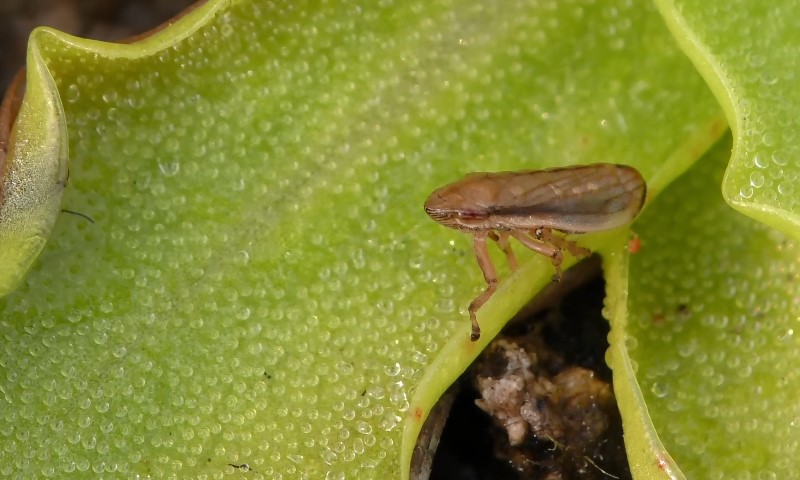
Butterworts, or Pinguicula species, use sticky leaves to catch tiny insects. Their leaves look soft, greasy, and harmless, but the surface is covered in secretions that trap prey.
Gnats, fruit flies, and springtails may mistake the pearly droplets for water. Once they land, they become stuck. Digestive enzymes break them down, and hollow chitin exoskeletons may be left behind.
Butterworts can also curl their leaves into a cup shape around prey, making the trap more effective.
Useful plant details include:
- Scientific name: Pinguicula species
- Native range: Eurasia, North America, South America, and Central America
- U.S. presence: naturally found in parts of the Southeastern United States
- Other common native areas: Mexico and areas around the United States
- USDA Growing Zones: 3 to 10
- Flower colors: yellow to purple
- Mature size: about ½ foot to 2 feet tall
Some butterworts can grow outdoors in mild-winter areas. Others work indoors as houseplants or terrarium plants when their light, moisture, and soil needs are met.
Butterwort is one of the less obvious carnivorous plants. It does not snap shut or form a deep pitcher. It simply holds prey in sticky goo and digests it on the leaf.
7. Bladderwort
Bladderworts, or Utricularia species, use underwater suction traps. Their hunting system is tiny, fast, and highly complex.
Small elastic bladders sit on the plant. When a tiny creature touches trigger hairs, a bladder opens and pulls in water.
Prey gets sucked inside like liquid entering a syringe. After that, the plant slowly squeezes water back out through filtering membranes while the prey stays trapped.
Bladderworts often catch daphnia, also called water fleas. They can also trap tiny insects and other small aquatic organisms.
Several facts show how varied this genus is:
- Scientific name: Utricularia species
- Species count: more than 200
- USDA Growing Zones: 4 to 11, depending on species
- Flower colors: yellow, blue, or purple
- Habitat needs: boggy or aquatic conditions
- Common bladderwort stem length: about 10 to 40 inches
- Humped bladderwort size: less than 8 inches
Bladderwort belongs on this list because it has one of the most ingenious trap mechanisms among carnivorous plants. Instead of sticky leaves or open pitchers, it uses a microscopic vacuum system.
8. Waterwheel Plant
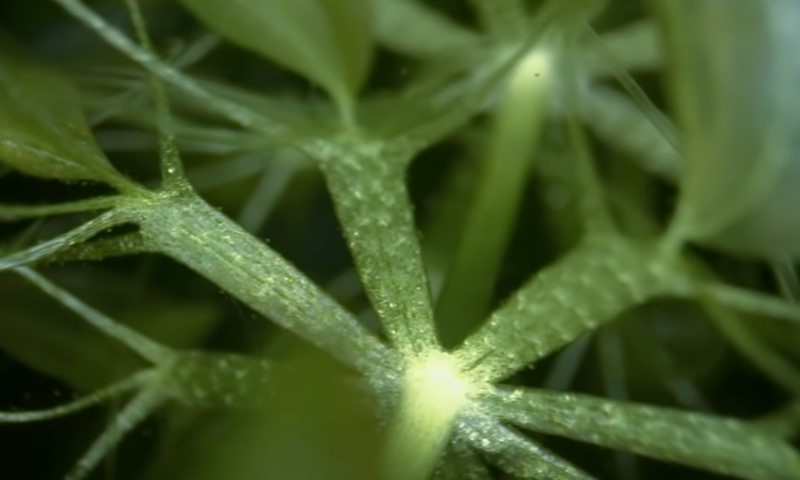
Waterwheel plant, or Aldrovanda vesiculosa, is the aquatic cousin of the Venus flytrap. It floats rootless on lake surfaces and catches prey with tiny snap traps.
Small traps grow in symmetrical whorls along the plant. Each whorl may contain about five to nine traps. When triggered, the trap can shut in as little as one-hundredth of a second.
Important traits make its connection to Venus flytrap clear:
- Scientific name: Aldrovanda vesiculosa
- Growth habit: rootless floating aquatic plant
- Trap type: snap trap
- Arrangement: traps set in whorls along the stem
- Speed: closure possible in one-hundredth of a second
- Related comparison: similar eating habits and physiology to the Venus flytrap
Waterwheel plant likely shares a common carnivorous ancestor with Venus flytrap dating to the Cenozoic Era. One hunts on land, while the other uses a similar trap design in water.
Its place on the list matters because snap-trap carnivory is not limited to terrestrial plants. Waterwheel plant shows how the same basic hunting method can work in an aquatic habitat.
9. Portuguese Sundew
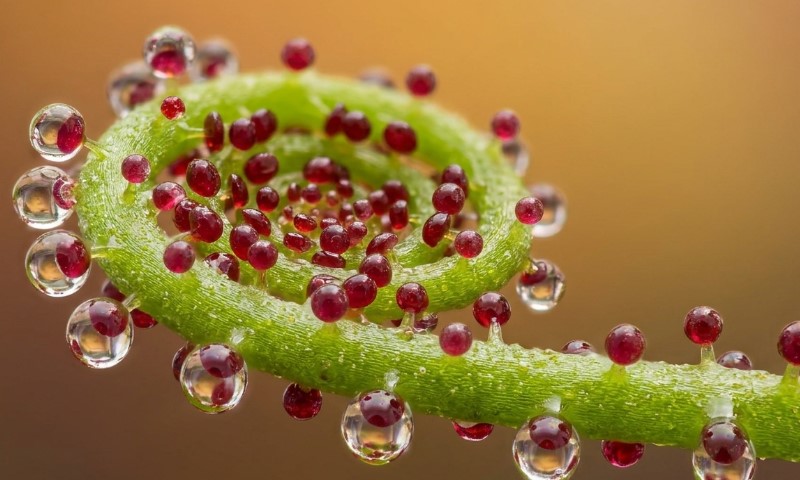
Portuguese sundew, or Drosophyllum lusitanicum, is a sticky-trap plant adapted to dry, nutrient-poor regions. Many carnivorous plants grow in wet bogs, but this species expands that pattern.
It grows in poor soil along the coasts of Spain, Portugal, and Morocco. Mediterranean-influenced coastal regions in southwestern Europe and northwestern Africa can be dry, yet the soil may lack enough nutrients. Insects help supply what the roots cannot.
Its feeding process is direct:
- Sweet aroma attracts insects.
- Sticky mucilage traps prey on the leaves.
- Digestive enzymes slowly dissolve the insect.
- Nutrients are absorbed through the leaf surface.
Portuguese sundew should not be confused with Drosophila, the fruit fly. Its scientific name, Drosophyllum, sounds similar but refers to the plant, not the insect.
Portuguese sundew is not a typical Drosera sundew. Its value in a list of carnivorous plants comes through its habitat. It proves insect-eating plants are not limited to wet, boggy places.
10. Western Australian Pitcher Plant / Moccasin Plant
@carnivorousplantsjourney Carnivorous plant CEPHALOTUS FOLICULARIS also known as “Australian pitcher plant” looking good this year 🔥🔥🔥 #carnivorousplant #tropicalplants #venusflytrap #flytrap #nepenthes #drosera #sundew #cephalotus #sarracenia #pitcherplant #plants #houseplants #tropical #exoticplants #rareplants #australianpitcherplant #garden #exotic #asianpitcherplant #stickyplant #flowers #greenhouse #grow #carnivore #hungryplants #greenthumb #nature #swamp #capensis #cephalotusfolicularis
Western Australian pitcher plant, or moccasin plant, is Cephalotus follicularis. It is small, compact, and built with detailed pitcher traps.
Moccasin-shaped pitchers attract insects with sweet scent. Once prey enters, it becomes trapped and slowly digested. Pitchers are small, striped, and often colorful, ranging in tone between green and dark purple.
A few details make this plant stand out:
- Scientific name: Cephalotus follicularis
- Native area: Southwest Australia
- USDA Growing Zones: 8 to 11
- Mature size: about 5 to 8 inches tall and 6 to 10 inches wide
- Pitcher size: about 1 to 1½ inches long
- Pitcher colors: green to dark purple
- Flower color: whitish and not very showy
- Light needs: full sun
- Common growing medium: sphagnum moss in pots
- Notable cultivar: ‘Eden Black,’ which can become dark enough to count as a rare black plant
Moccasin plant is one of the smallest pitcher plants. Its size makes the trap easier to overlook, but each pitcher still works as an insect trap.
A notable botanical detail sets it apart. Moccasin plant is more closely related to flowering plants such as apple trees and oak trees than to many other carnivorous pitcher plants. Similar pitcher forms appeared separately because similar survival pressures shaped unrelated plant groups.
Closing Thoughts
Carnivorous plants survive in nutrient-poor habitats by turning leaves into traps. Some snap shut, some drown prey, some glue insects in place, and some use suction underwater.
Venus flytrap and waterwheel plant use snap traps. Tropical pitcher plant, purple pitcher plant, cobra lily, and Western Australian pitcher plant use pitfall traps. Sundew, butterwort, and Portuguese sundew use sticky traps. Bladderwort uses suction traps.
Most carnivorous plants eat insects. Larger pitcher plants may also trap small vertebrates, including lizards, amphibians, birds, or small mammals. Beautiful does not mean harmless when a plant has learned to hunt.